


The Short Answer: Cash basis accounting records revenue when cash hits your bank account and expenses when payment leaves. Accrual basis accounting records revenue when it’s earned and expenses when they’re incurred, regardless of when cash actually moves. Most law firms default to cash basis because it’s simpler, but that choice affects how your financial statements read, how your taxable income is calculated, and whether the numbers you’re looking at actually reflect the financial health of your firm.
When most firms open, your accountant sets you up on cash basis accounting, and you never think about it again. As the firm grows, takes on more complex cases, and starts carrying larger balances in unpaid invoices and accrued expenses, that default choice starts creating blind spots.
Those blind spots tend to show up at tax time, when the numbers on your income statement don’t match what you expected, and the decisions you made based on those numbers turn out incorrect. The accounting method you chose years ago may no longer fit where your firm is today.
Important Context: Your tax accounting method does not necessarily have to match the method you use for internal management reporting. Some law firms maintain accrual-based financial reports for decision-making while filing federal income taxes on the cash method when permitted.
Cash vs. Accrual Accounting: How They Work
Cash Basis Accounting
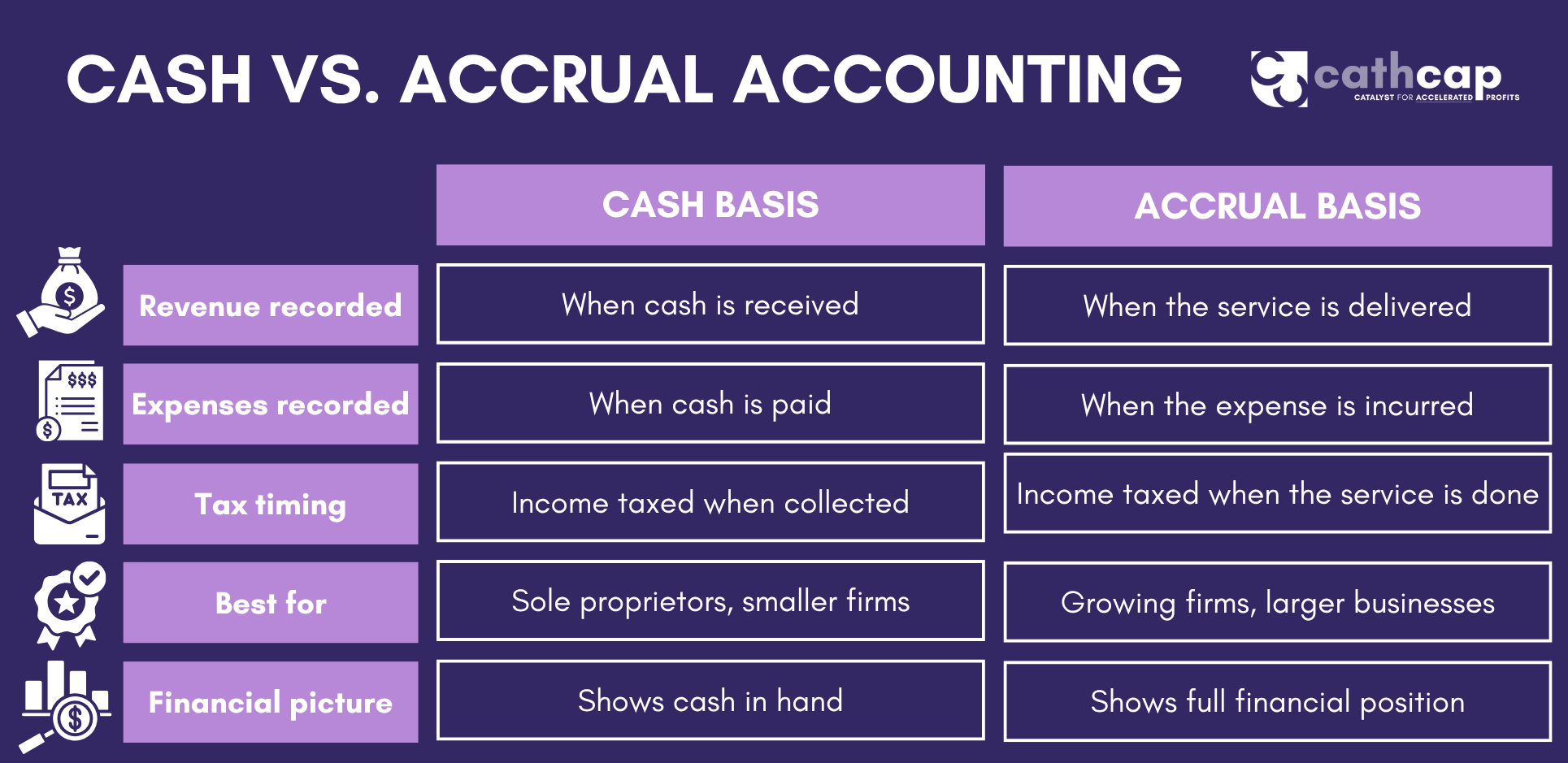
With cash basis accounting, revenue is recorded when cash lands in your bank account and expenses are recorded when payment goes out. If a client pays you in March for work you did in January, that revenue shows up in March. A credit card payment to a vendor in April counts as an April expense, even if the service was delivered back in February.
The cash method is straightforward and easy to manage in most accounting software. What you see in your bank account closely matches what your financial reports show. For sole proprietors and smaller law firms with simple billing, this is usually enough.
The trade-off is that the cash basis doesn’t account for work you’ve done but haven’t been paid for yet or expenses you’ve committed to but haven’t paid. Your financial statements only reflect what has already moved through the bank account, not what’s owed in either direction.
Accrual Basis Accounting
Accrual basis accounting follows the matching principle: revenue is recorded when it’s earned, and expenses are recorded when they’re incurred, regardless of when cash actually changes hands. If you complete work for a client in January but don’t collect payment until March, that revenue is recognized in January under the accrual method.
This approach aligns with GAAP standards and gives a more accurate picture of the firm’s financial position at any given point. You can see what the firm has earned, what it owes, and what’s still outstanding on the balance sheet, all in real time.
The IRS can restrict the use of cash accounting depending on the firm’s entity structure, tax status, and other factors. For 2026, the Section 448 gross receipts threshold is $32 million in average annual gross receipts over the prior three tax years, but important exceptions apply. Qualified personal service corporations, including qualifying law corporations, may be able to continue using the cash method regardless of that threshold.
What Law Firms Get Wrong
Defaulting to Cash Basis
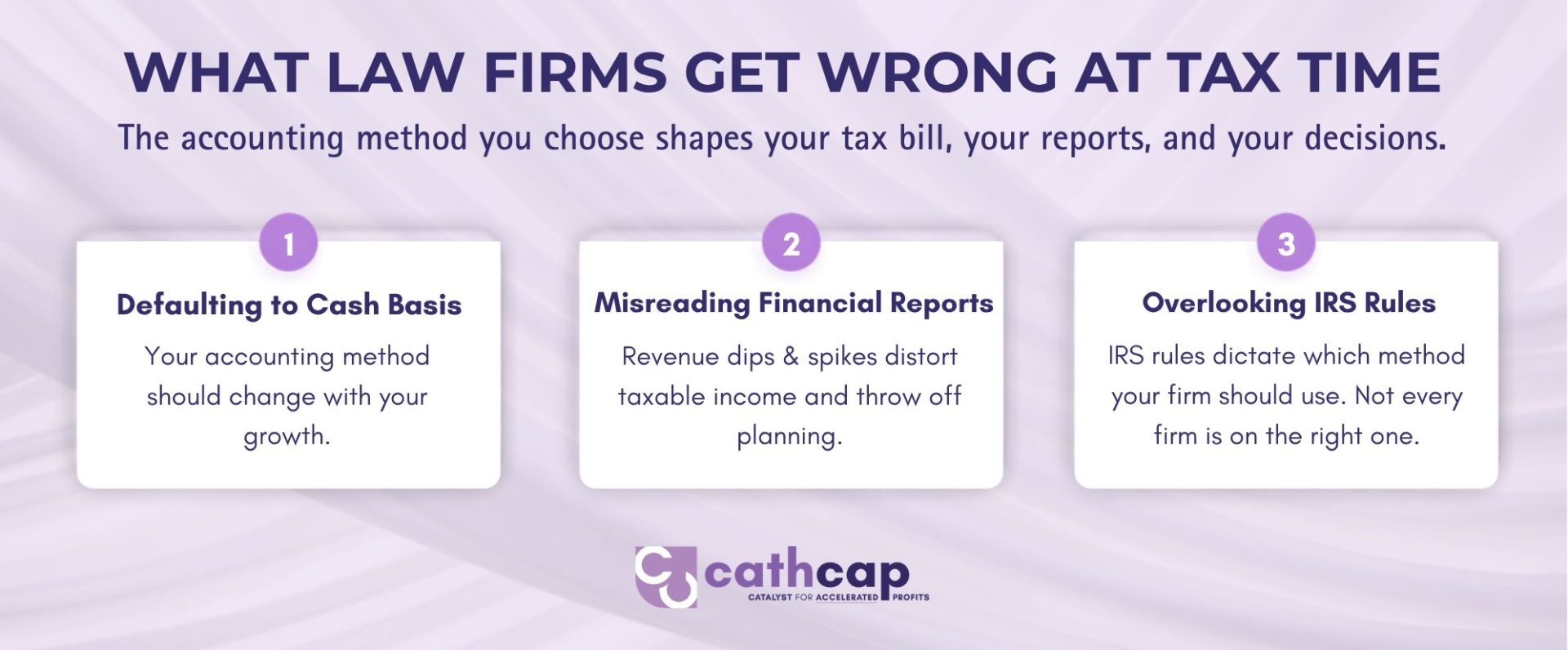
Most law firms land on cash basis accounting because it’s what their accountant set up on day one. For a sole proprietor or a small firm in its early stages, that makes sense. Cash accounting is simple, the books are easy to maintain, and the numbers in your bank account line up with what your financial reports show.
The problem isn’t choosing the cash basis. It’s never revisiting the decision as the firm grows. A firm billing $500,000 a year with straightforward cases has very different accounting needs than one billing $3M with contingency work, retainers, and 60-day collection cycles. When the complexity of your financial transactions outgrows the simplicity of your accounting method, the numbers you’re relying on stop telling the full story.
Misreading Financial Reports at Tax Time
Say your firm performs and bills $100,000 in hourly work during December, but the client doesn’t pay those invoices until February. Under cash basis accounting, that revenue won’t show up in your financial reports until February, when the cash actually hits your bank account. So December looks like a slow month on paper, even though your team did the work and sent the invoices. And February looks stronger than it actually was because it’s reflecting work performed two months earlier.
Under accrual accounting, that same $100,000 would be recognized in December when the work was performed and billed. That gives you and your leadership team a clearer picture of what the firm actually produced during that period, which matters when you’re evaluating performance, planning for expenses, or making financial decisions heading into the next fiscal year.
When business owners only see the cash picture, they’re making decisions based on when money moved rather than when the work was done. Over a full year, those timing gaps can add up and distort both your taxable income and your view of the firm’s financial health.
Not Understanding the IRS Rules
The Internal Revenue Service has specific rules about which accounting method a firm can and should use. These rules tie back to the firm’s average annual gross receipts and entity structure, and they’ve changed over time as the Internal Revenue Code has been updated.
Some firms are using the wrong method without realizing it, which creates regulatory requirement issues that don’t surface until an audit or a tax filing gets questioned. This isn’t an area to guess on. If you’re unsure whether your firm meets the threshold or whether your current method is compliant, a fractional CFO can review your situation, identify any gaps, and make sure your financial reporting aligns with IRS rules before the next tax deadline.
Which Method Is Right for Your Law Firm?
When Cash Basis Makes Sense
Cash basis accounting works well for firms that are smaller, have straightforward billing, and don’t carry large balances in unpaid invoices. If you’re a sole proprietor handling a manageable caseload with most clients paying at or near the time of service, cash accounting gives you a simple, clear view of cash flow without the added bookkeeping overhead.
For firms under the IRS gross receipts threshold of $32 million, cash basis also keeps tax purposes simple. Your taxable income lines up with what you actually collected during the fiscal year, which makes tax planning more predictable.
When Accrual Makes Sense
As a firm grows, the gap between when work is performed and when cash is collected tends to widen. Larger businesses and mid-sized firms with retainer-based billing, contingency cases, or long collection cycles often find that the cash basis no longer reflects the firm’s true financial position.
Accrual basis accounting gives you a more complete picture. You can see revenue earned, expenses incurred, and outstanding balances on the balance sheet at any point. That visibility matters when you’re making decisions about hiring, expanding into a new practice area, or preparing financial reports for a potential partner or lender.
If your firm needs accurate financial statements to guide strategic decisions rather than just a snapshot of what’s in the bank account, accrual is usually the stronger fit.
The Hybrid Approach
Some firms use a hybrid approach, running accrual accounting for internal financial reporting and day-to-day financial management while filing taxes on a cash basis. This gives you the operational efficiency and accuracy of accrual for decision-making without overcomplicating your tax filing.
Why This Is a Financial Strategy Decision
The accounting method you use shapes how you read your numbers, how you plan around tax time, and how you make financial decisions throughout the fiscal year.
For law firm owners specifically, the stakes are higher than most realize. Your accounting method determines whether your financial reports reflect actual performance or just cash timing. It affects how you evaluate profitability, when you recognize revenue, and whether your personal finances and business finances are aligned at tax time.
This is a financial management question, not just an accounting one. And it’s the kind of question a fractional CFO is built to help with. At Cathcap, we work with law firm owners to evaluate which accounting method fits their firm’s size, structure, and goals. We build the financial reporting to match, and we make sure the numbers you’re looking at actually support the decisions you need to make. Book a free consultation and let’s take a look at where your firm stands.
Frequently Asked Questions
What is the difference between cash and accrual accounting?
Cash basis accounting records revenue when cash is received and expenses when cash is paid. Accrual basis accounting records revenue when it’s earned and expenses when they’re incurred, regardless of when the money moves. The difference affects your financial statements, your taxable income, and how accurately your books reflect the firm’s financial health.
Can a law firm switch from cash to accrual accounting?
Yes, but it requires filing Form 3115 with the Internal Revenue Service and making adjustments to your financial records. The transition affects your balance sheet, your income statement, and potentially your tax liability for the year of the change. It’s not something to do without professional guidance.
How does Cathcap help law firms choose the right accounting method?
Cathcap evaluates your firm’s revenue, billing structure, and growth trajectory to determine which method gives you the most accurate financial picture. We then build the reporting and cash flow management processes to support it so the numbers you see match the decisions you need to make.
What are the signs my law firm should consider switching to accrual?
If your firm carries a growing balance in unpaid invoices, manages retainer-based billing, or finds that your financial reports don’t match the work your team actually performed during the fiscal year, those are signs that the cash basis may no longer fit. Firms that need accurate financial statements for hiring decisions, bringing on a partner, or securing financing also tend to benefit from the switch.


Recent Comments