


The Short Answer: A CFO helps a scaling business turn financial complexity into clarity. At the $5M–$50M stage, that means managing cash flow, building forecasts, tightening business operations, and giving the leadership team the data they need to make smarter growth decisions.
When a business crosses the $5M revenue mark, the financial complexity changes fast. Cash flow gets harder to manage, profit margins face new pressure, and the decisions that got you here aren’t always the ones that will get you to $50M. This is the stage where most business owners realize they need more than a bookkeeper or a financial controller. They need a CFO.
A CFO at this level isn’t just tracking numbers. They’re helping you understand what those numbers mean for your next move. They forecast cash flow, tighten business processes, and prepare the business for investor conversations. It’s a leadership role, not a back-office function.
This blog breaks down what a CFO actually does for businesses in the $5M to $50M range, the most common challenges they help solve, and how to know when it’s time to bring one on.
Why $5M–$50M Is Where Businesses Hit a Financial Ceiling
What Changes at This Stage
In the early stages of a business, the owner usually has a handle on the money. Revenue is simpler to track, expenses are manageable, and gut instinct can fill in the gaps. That changes once the business starts scaling past $5M.
Cash flow becomes harder to predict. You’re hiring new employees, expanding into new markets, and managing more moving parts across the business. Profit margins that looked strong at $3M can quietly compress at $10M if no one is watching the numbers closely. Business operations that worked with a small team start breaking down under the weight of rapid growth.
At this point, the business owner is often still the primary financial decision-maker, but without the tools, data, or time to do it well.
The Gap Between Bookkeeping and Financial Leadership
Most businesses in this range have a bookkeeper or a financial controller handling the day-to-day accounting. That’s important work, but it’s backward-looking. It tells you what already happened.
What’s missing is someone focused on what’s coming next. A CFO provides strategic planning, financial forecasting, and the ability to connect your financial data to real business decisions. They look at your business model, your growth trajectory, and your cash position to help you plan rather than react.
That gap between bookkeeping and financial leadership is where scaling businesses get stuck. The numbers are there, but no one is translating them into a plan.
What a CFO Actually Does at This Stage
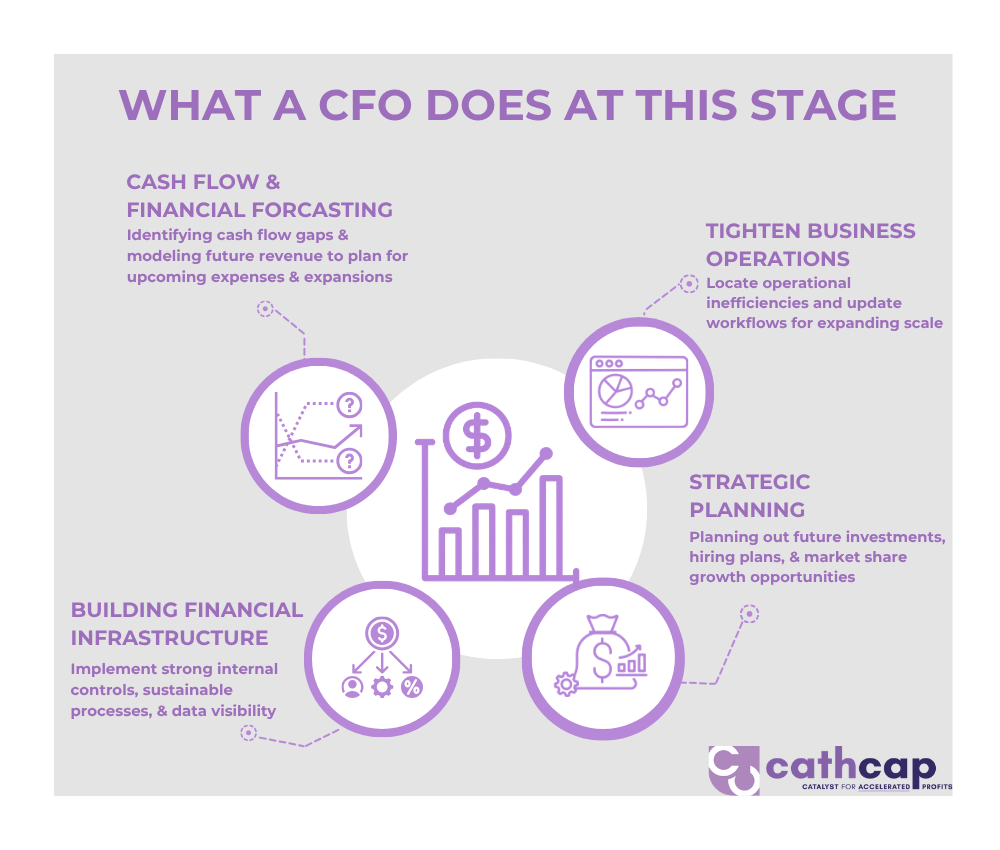
Cash Flow and Financial Forecasting
Cash flow is one of the first things that gets complicated during a rapid growth phase. Revenue might be climbing, but if your expenses are growing faster or your receivables are lagging, you can run into trouble quickly. A CFO builds forecasting models that give you a clear picture of where your cash is going and when gaps are likely to show up.
That visibility lets you plan ahead for big expenses like new hires, equipment, or market expansion instead of scrambling to cover them in the short term.
Tightening Business Operations
Growth tends to expose operational inefficiencies that weren’t visible at a smaller scale. Processes that worked when you had 10 employees don’t always hold up at 50. A CFO looks at how money moves through the business and identifies where service delivery, vendor relationships, or internal workflows are costing more than they should.
The goal isn’t to cut corners. It’s to make sure every dollar supports the business model and contributes to sustainable growth.
Strategic Planning and Growth Decisions
At this stage, the leadership team faces bigger decisions more often. When do you hire? Where do you invest? Which product lines or services are actually driving profit margin? A CFO brings financial data into those conversations so decisions are grounded in numbers rather than instinct alone.
This is also where business development strategy gets sharper. A CFO can help evaluate whether chasing new customers or deepening relationships with existing ones is the better path to market share growth.
Building Financial Infrastructure
A scalable business needs financial systems that can grow with it. That means accurate financial reporting, strong internal controls, and processes that give business leaders real-time visibility into performance. A CFO builds that infrastructure so the business isn’t relying on spreadsheets and manual workarounds as it scales.
This work also prepares the business for outside scrutiny, whether that’s a bank, an angel investor, or a potential acquirer reviewing your numbers during due diligence.
Scaling Challenges a CFO Helps You Navigate
People and Hiring
One of the most common challenges during business growth is hiring. Bringing on new employees too quickly can drain cash. Hiring too slowly can stall momentum. And hiring the wrong person in a key role can set the business back months.
A CFO helps you build a capacity plan tied to your financial data so you know when you can afford to hire, what each role will cost, and how it impacts your profit margin. That takes the guesswork out of one of the most expensive decisions a business owner makes.
Profit Margins and Revenue Traps
It’s easy to get focused on top-line revenue during a rapid growth phase and lose sight of what’s actually hitting the bottom line. Some businesses scale their way into thinner margins without realizing it because they haven’t adjusted pricing, renegotiated vendor terms, or evaluated which products and services are truly profitable.
A CFO keeps profit margin visible and ties it back to your business model. If growth is costing more than it should, they’ll spot it early and help you course correct before it becomes a bigger problem.
Systems, Tools, and New Technologies
As a business scales, the tools and systems that got you through the early stages start showing their limits. You might be outgrowing your accounting software, managing inventory across disconnected platforms, or evaluating new technologies like artificial intelligence or cloud-based solutions to improve efficiency.
A CFO helps you evaluate these decisions financially. Not every new tool is worth the investment, and the wrong system can create more problems than it solves. They make sure technology decisions support business operations rather than adding complexity.
M&A and Investor Readiness
Growth sometimes brings opportunities that require a different level of financial preparation. An angel investor might want to see a detailed slide deck with clean financials. A potential acquisition target might need due diligence support. Or you might be approached about a merger that could accelerate your market share.
A CFO makes sure your financial house is in order for these conversations. They prepare the reporting, build the models, and help you present your business with credibility. For business leaders navigating these moments for the first time, that kind of support can be the difference between a deal moving forward or falling apart.
When to Bring in a CFO
Signs It's Time
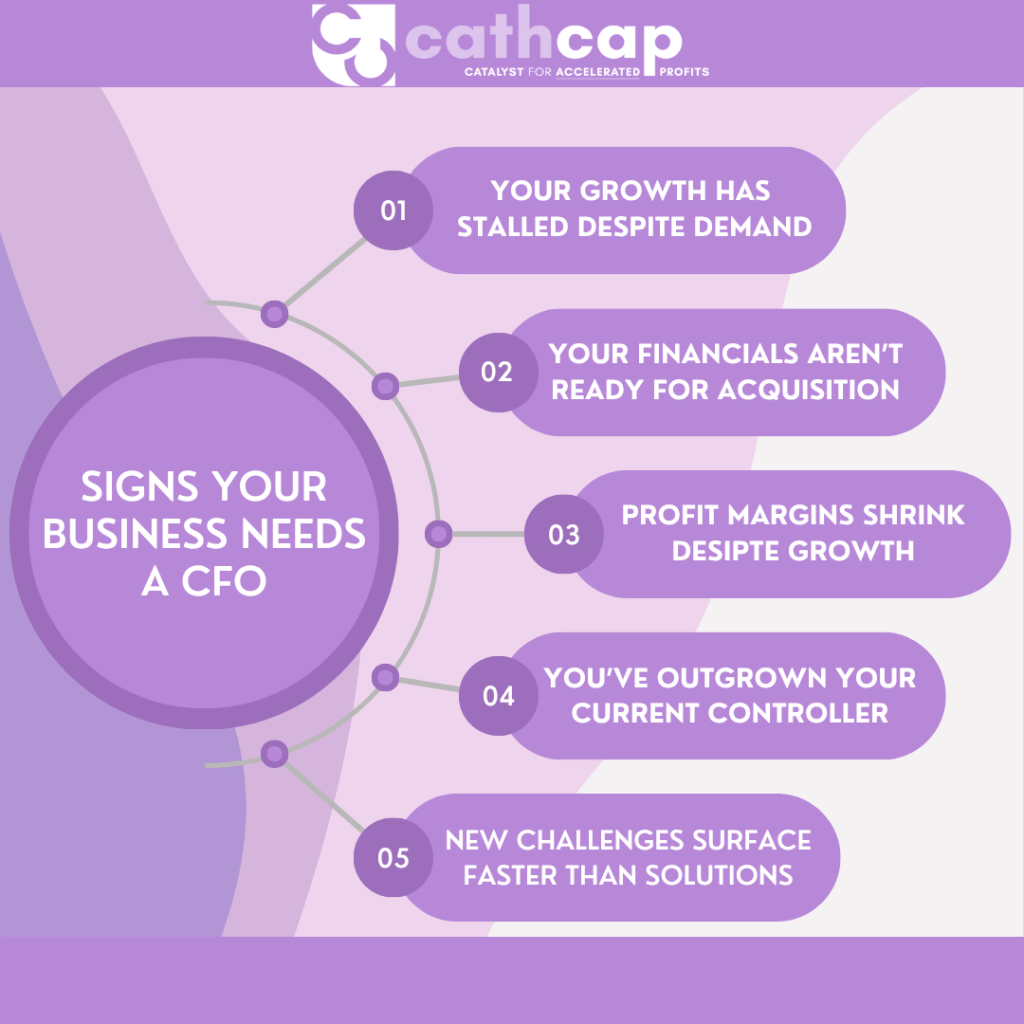
Most business owners don’t wake up one day and decide they need a CFO. It usually shows up as a pattern. Cash flow surprises keep happening. Financial decisions feel reactive instead of planned. The leadership team is stretched thin and spending time on financial questions they aren’t equipped to answer.
Other signs include:
-
Growth is stalling even though demand is there
-
You're preparing for a funding round or acquisition and your financials aren't ready
-
Profit margins are shrinking but no one can explain why
-
You've outgrown your financial controller or bookkeeper's skill set
-
New challenges keep surfacing faster than your team can solve them
If more than one of these sounds familiar, your business has likely hit the point where financial leadership needs to be a dedicated role.
Full-Time vs. Fractional
For a business in the $5M to $50M range, the decision often comes down to what you need and what you can afford. A full-time CFO brings daily presence and deep organizational knowledge. But for many small and mid-sized businesses, the cost of a full-time hire doesn’t match the stage they’re in.
A fractional CFO gives you the same caliber of strategic planning, cash flow management, and financial leadership on a schedule that fits your business. You get senior-level support without the overhead of a full-time executive.
If your business is navigating the scaling challenges covered in this post and you want experienced financial guidance without the full-time commitment, a fractional CFO is a practical path forward. Cathcap works with businesses in this exact range, providing the financial leadership that helps business owners scale with confidence. Book a free consultation today.
Frequently Asked Questions
A financial controller manages day-to-day accounting, reporting, and compliance. A CFO operates at a strategic level, focusing on cash flow forecasting, growth planning, and helping the leadership team make data-backed decisions. Both roles are valuable, but they serve different functions.
Yes. Many businesses in this range don’t need or can’t justify a full-time CFO. A fractional CFO provides the same level of strategic planning and financial leadership on a part-time or project basis, scaled to your specific needs and budget.
A CFO brings structure to the financial side of growth. That includes building forecasts, tightening business processes, evaluating hiring decisions, improving profit margins, and preparing the business for investor or M&A conversations. They help you make smarter decisions at every stage of the scaling process.


Recent Comments