


The Short Answer: Valuing a law firm starts with one question: how much of the firm’s revenue stays if the owner leaves? Separating owner value from firm value gives you a clearer picture of what your practice is actually worth and puts you in a stronger position for a sale, partnership change, or succession planning.
You’ve built a successful legal practice, and the numbers reflect that. But a potential buyer or successor isn’t looking at what the firm earns today. They’re looking at what it earns without you. The more revenue that depends on your personal relationships and reputation, the more the firm’s value is tied to you rather than the business itself.
Knowing how to value a law firm means understanding where that value lives and what you can do to strengthen it. This blog covers the difference between owner value and firm value, the most common valuation methods, and the factors that move a law firm’s value in either direction.
The Difference Between Owner Value and Firm Value

What Is Owner Value?
Owner value is the portion of revenue that depends on you personally. It includes the client relationships you manage directly, the referral sources that call because of your name, and the billable hours only you can produce. If a client were to leave the firm the day you did, that revenue falls into this category.
For solo practitioners and smaller firms, owner value often makes up the majority of the firm’s revenue. That’s natural in the early years of building a legal practice. But if it stays that way, it creates a ceiling on what the firm is worth to anyone other than you.
Owner value isn’t a weakness. It’s a reflection of the personal relationships and reputation you’ve built over the course of your career. The goal isn’t to eliminate it. It’s to build firm value alongside it so the practice can stand on its own.
What Is Firm Value?
Firm value is the revenue, infrastructure, and client base that operate independently of any single person. It’s the part of the business a potential buyer is actually paying for because it continues to generate income after the transition.
Firm value shows up in areas like:
A diversified client base where no single attorney holds all the relationships
Recurring revenue streams tied to the firm’s practice areas rather than one person’s book of business
Documented processes for client intake, billing, and case management
A team of attorneys and staff who drive results without direct owner involvement
A recognizable brand within the legal profession that attracts clients on its own
The stronger these elements are, the higher the firm’s value in a law firm valuation. A practice with $3M in revenue where $2.5M depends on the owner is worth far less than a $2M firm where the revenue is spread across multiple attorneys and institutional client relationships.
How to Value a Law Firm
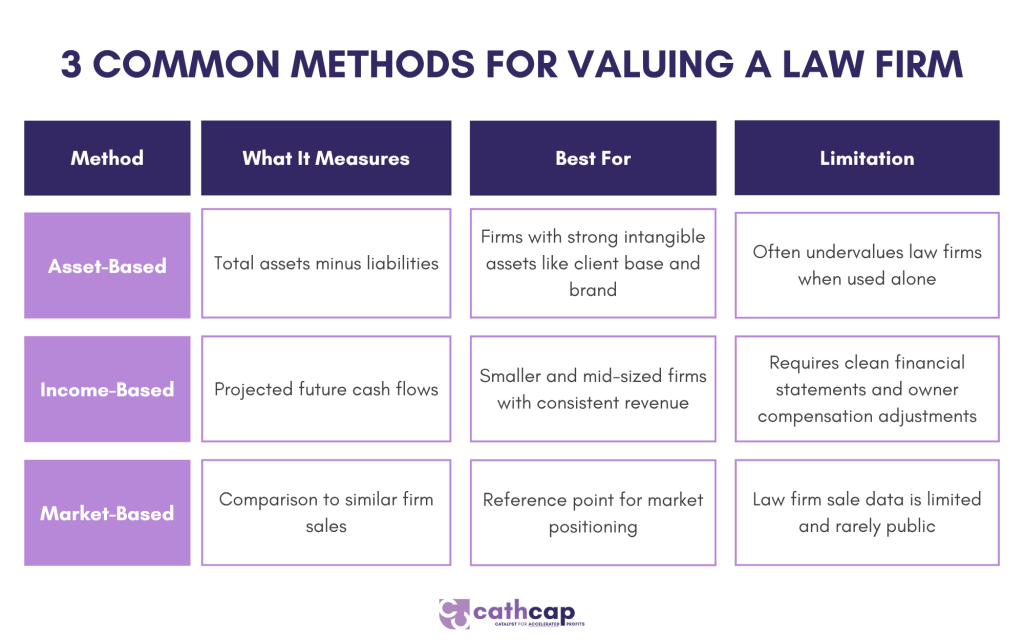
There are several different methods used in business valuation, and each one tells you something slightly different about what your firm is worth. For most law firms, a combination of approaches gives the most accurate picture.
To show how each method works in practice, we’ll use a fictional example: Carter & Associates, a personal injury firm with three attorneys, $2.5M in annual revenue, and $400,000 in net income after the owner’s $350,000 salary.
Asset-Based Valuation
The asset-based approach adds up everything the firm owns, both tangible assets and intangible assets, then subtracts liabilities. Tangible assets include things like office furniture, equipment, real estate, and cash on hand. Intangible assets include your client base, brand reputation, intellectual property, and practice area expertise.
Carter & Associates example:
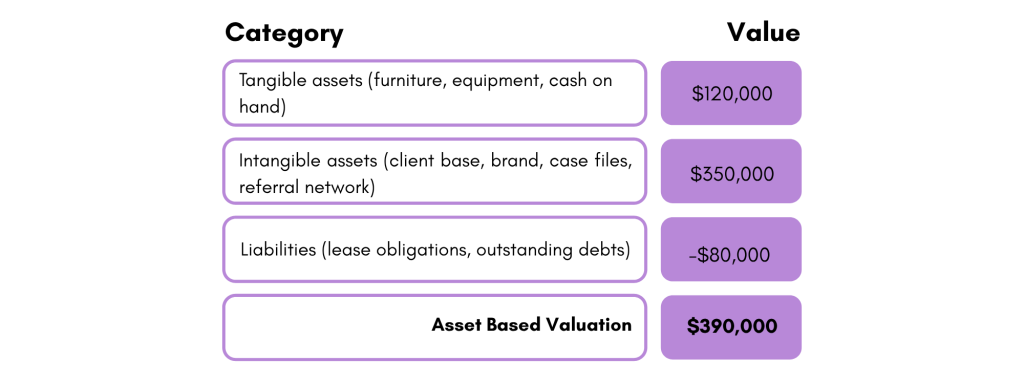
For most law firms, the tangible assets alone don’t add up to much. The real value sits on the intangible side. A strong client base with diversified revenue, a respected name in the legal industry, and documented processes all carry weight in the valuation process. The American Bar Association recognizes intangible assets as a primary driver of value in legal practice transitions, which is why an asset-based valuation on its own often underestimates what a firm is truly worth.
Income-Based Valuation
This method values the firm based on its future cash flows and earning potential. It starts with historical financial statements, revenue trends, and profit margins, then applies a valuation multiple to the firm’s seller’s discretionary earnings (SDE).
SDE represents the total financial benefit available to an owner. You calculate it by adding the owner’s salary back to net income, then adjusting for any personal expenses run through the business. For smaller firms and mid-sized firms, SDE is the most common earnings metric used in a firm valuation because it gives a potential buyer a clear picture of what the business actually generates.
Carter & Associates example:
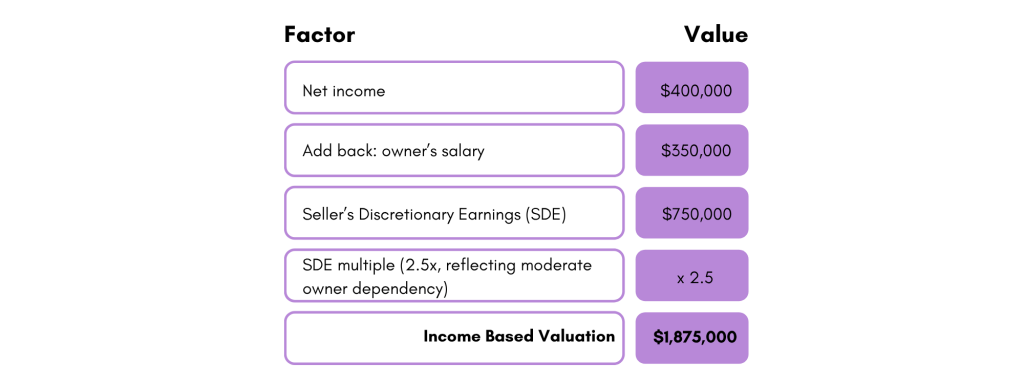
The multiple reflects risk. Law firms typically transact at SDE multiples between 2.44x and 2.84x (Source: Peak Business Valuation). A firm with high owner dependency, inconsistent revenue, or a concentrated client base will fall toward the lower end. A firm with distributed relationships, predictable cash flow, and diversified fee structures earns a higher multiple.
Carter & Associates lands at 2.5x because the owner still drives a large portion of client relationships. If the firm reduced that dependency and diversified its revenue streams, a multiple closer to 3x or higher would be realistic, pushing the valuation above $2.2M.
Market-Based Valuation
The market-based approach compares your firm to similar practices that have recently sold. It looks at revenue multiples to estimate what your firm might be worth in the current market. According to data from Peak Business Valuation, law firms generally transact at a revenue multiple between 0.87x and 1.21x.
Carter & Associates example:
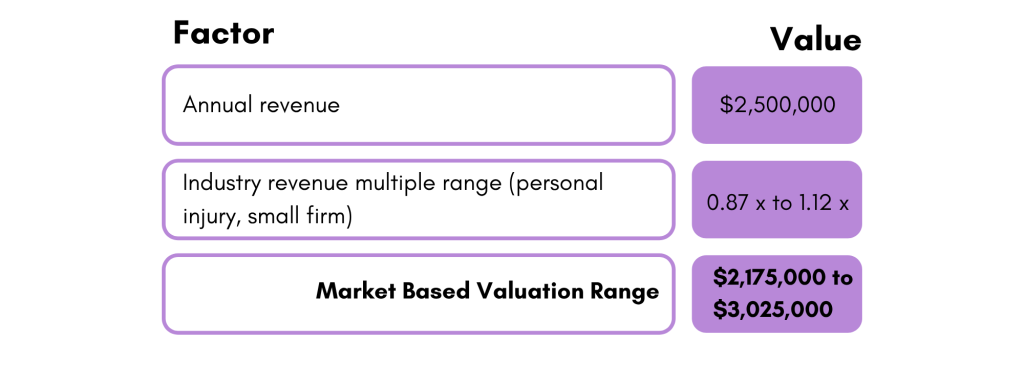
Where Carter & Associates actually falls within that range depends on the main factors we’ve been discussing: owner dependency, client concentration, and the strength of the team. A firm with strong firm value lands closer to the top. A firm where most revenue is tied to the owner lands closer to the bottom.
The challenge with this method in the legal industry is transparency. Law firm sales are rarely made public, and deal terms vary widely based on unique circumstances like geography, practice area, and client concentration. The Small Business Administration recommends using market comparisons alongside other valuation methods rather than in isolation.
How the Methods Compare
No single method gives you the full picture. The asset-based approach undervalues Carter & Associates because most of the firm’s worth is in its earning power, not its physical assets. The income-based method gives the most specific number but depends heavily on how owner dependency and risk are calculated. The market-based method provides a range but lacks precision without strong comparable data.
Most valuation experts recommend using at least two methods together to arrive at a realistic estimate of what your law firm is worth.
What Most Firm Owners Get Wrong About Valuation
Owner Dependency Discounts More Than You Think
Most firm owners understand that high owner dependency is a concern. What they don’t always realize is how aggressively a potential buyer discounts for it. If 70% of revenue is tied to your personal relationships and production, a buyer isn’t valuing the firm at your current revenue. They’re projecting what happens after you leave, and they’re applying a risk discount to every dollar that might walk out the door with you.
A firm generating $2M with well-distributed client relationships across four attorneys can carry a higher valuation than a $3M firm where the owner personally manages 80% of the book. Buyers are paying for revenue they can keep, not revenue they hope survives.
Owner Compensation Adjustments Change the Math
This is where many firm owners are surprised during the valuation process. When a buyer looks at your financial statements, one of the first things they do is adjust for owner compensation. If you’re paying yourself $600,000 from a firm that nets $700,000, the buyer needs to understand what the firm earns after replacing your role at a market-rate salary.
That adjustment can significantly change the firm’s perceived profitability, and in many cases, it’s the moment a firm owner realizes their practice is worth less than they expected. Working with a financial advisor to run these numbers before going to market helps you avoid that surprise and gives you time to improve the picture.
Buyers Look at Things You Probably Don't
Firm owners tend to focus on revenue and client relationships when thinking about their firm’s value. Buyers look deeper. They evaluate:
- Staff retention risk: Will key attorneys and support staff stay after the transition, or will the owner’s departure trigger turnover?
- Transferability of relationships: Are client relationships documented in the firm’s systems, or do they live in the owner’s phone and memory?
- Lease and contract exposure: Long-term real estate leases, vendor contracts, and partnership agreements all affect the financial picture a buyer inherits.
- Revenue quality: A dollar of recurring retainer revenue from a long-term client is worth more than a dollar of one-time project work. Buyers look at fee structures and how predictable the firm’s revenue streams are over time.
Growth Potential Only Counts If the Infrastructure Is There
It’s common for firm owners to factor in growth potential when estimating their firm’s value. New practice areas, untapped markets, or adopting artificial intelligence for legal research all sound like upside. But a buyer won’t pay for potential they have to build the foundation for themselves.
Growth potential adds value when the systems, team, and cash flow are already in place to support it. If the firm has capacity, documented processes, and attorneys who can take on new work, that’s real upside. If it’s just an idea without infrastructure behind it, a buyer sees a cost, not an asset.
How to Close the Gap Between Owner Value and Firm Value
If the gap between what you generate personally and what the firm generates on its own is wide, that’s not a problem to solve in the final months before a sale. Closing that gap is a multi-year process that touches how you manage clients, develop your team, and structure the firm’s finances.
A few practical places to start:
- Shift client relationships gradually. Introduce other attorneys into your key accounts now, not when you’re heading for the door. Clients who build trust with a second attorney over time are far more likely to stay through a transition.
- Build leadership depth. Give senior associates or non-equity partners more responsibility over business development, client management, and internal decision-making. The more the firm’s performance depends on the team rather than one person, the stronger the firm’s value becomes.
- Diversify revenue. If one practice area or a handful of clients represent the bulk of your income, explore where the firm can grow into adjacent legal services or deepen relationships with underserved parts of your existing client base.
- Get your financials in order early. Clean financial reporting, clear owner compensation records, and organized cash flow documentation make the valuation process faster and the firm more attractive to a potential buyer.
This is where working with a fractional CFO can make a real difference. A financial advisor who understands law firm economics can help you see the gap clearly, build a plan to close it, and track your progress over time so the firm is in the strongest position possible when you’re ready to make a move.
If you’re starting to think about what comes next for your practice, whether that’s a sale, a partnership transition, or building toward an exit, the earlier you start the better your options will be. Book a free consultation with Cathcap to start the conversation.
Frequently Asked Questions
Can a fractional CFO help with law firm valuation?
Yes. A fractional CFO can help firm owners understand what their practice is worth by cleaning up financial reporting, running owner compensation adjustments, and identifying the factors that are driving or reducing the firm’s value. At Cathcap, we work with legal professionals to build financial clarity that supports smarter decisions around valuation, succession planning, and exit strategy.
What’s the biggest factor that reduces a law firm’s value?
Owner dependency. When a firm’s revenue, client relationships, and daily operations center around one person, a buyer sees risk. The more revenue that stays without the owner, the higher the firm’s valuation. Reducing that dependency by building a strong team, distributing client relationships, and documenting processes is the most effective way to increase what your practice is worth.
How long does it take to improve a law firm’s value before selling?
Most firm owners need two to three years to meaningfully shift value from themselves to the firm. That includes transitioning client relationships, building leadership depth, diversifying revenue streams, and getting financials in order. Starting early gives you more control over the process and a stronger outcome.


Recent Comments