


The Short Answer: Law firm forecasting helps you make growth decisions based on where your firm is headed, not just where it’s been. When you can project revenue, cash flow, and capacity with confidence, you hire at the right time, avoid cash surprises, and put resources into the practice areas that are actually growing.
You already know how last month went. You can see revenue, review expenses, and check the bank account. But when it comes to planning for next quarter or next year, that clarity tends to fade. And when you’re managing a caseload on top of running the business, building a financial model usually isn’t at the top of your list.
That’s a common reality for many legal professionals running their own firms. The day-to-day demands of practicing law take priority, and financial planning gets pushed to the side. The problem is that without a forecast, you’re making some of your biggest decisions, like when to hire, how much to invest in marketing, or whether to expand into a new practice area, based on instinct instead of data.
A financial forecast gives you a clearer view of what’s ahead. It takes your historical data, revenue trends, and key metrics and turns them into a forward-looking picture you can actually
What a Good Financial Forecast Looks Like
The Key Metrics That Matter
A financial forecast doesn’t need to be complicated to be useful. At its core, it’s a projection of revenue, expenses, and cash flow over a set period, usually 12 months, updated regularly as actual performance comes in.
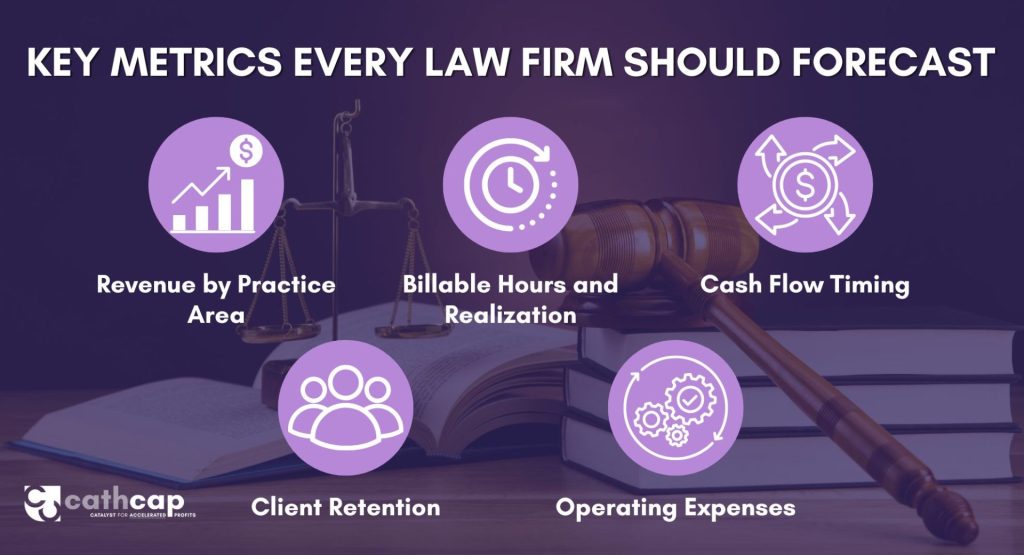
For law firms, the key metrics worth tracking in a forecast include:
- Revenue by practice area and attorney: Shows you where the firm is generating income and which areas are trending up or down.
- Billable hours and realization rate: Billable hours tell you how much work is being done. The realization rate tells you how much of that work actually turns into collected revenue. “According to the 2025 Clio Legal Trends Report, the average realization rate for law firms sits at 88%, which means roughly 12% of billable work never makes it to a client invoice.”
- Cash flow timing: Revenue earned and revenue collected are two different things. A forecast tracks when money is expected to come in and when it needs to go out so you’re not caught off guard.
- Client retention and new client trends: Are your existing clients staying? Is your pipeline of new work keeping pace with the firm’s expenses? Both of these feed directly into revenue projections.
- Operating expenses as a percentage of revenue: Helps you understand how much of every dollar earned goes to overhead and whether that ratio is healthy as the firm grows.
These aren’t vanity metrics. They provide valuable insights that tell you whether the firm can afford to hire, invest, or expand, and when.
Forecasting vs. Budgeting
Firm owners sometimes treat forecasting and budgeting as the same thing. They’re related, but they serve different purposes.
A budget is a plan for how you intend to spend. It’s typically set once a year and stays relatively fixed. A financial forecast is closer to an outcome prediction, a projection of what’s likely to happen based on current trends, and it updates as new data comes in. When actual performance lands above or below the forecast, you adjust the model and your strategy along with it.
Both are useful tools for financial management. But forecasting is what drives strategic planning because it’s responsive. It gives firm leaders a live picture of the firm’s financial health rather than a static spending plan set months ago.
Why Most Law Firms Don't Forecast Well
The Backward-Looking Trap
Most law firms have some level of financial reporting in place. Monthly P&L statements, bank account reviews, maybe a quarterly check-in with an accountant. That gives you a picture of what happened, which is valuable, but it’s not the same as knowing what’s coming.
When your only financial visibility is backward-looking, decisions become reactive. You hire when you’re already overwhelmed. You cut costs after cash gets tight. You realize a practice area is underperforming months after the trend started. The American Bar Association has highlighted the importance of law firms moving beyond basic financial reports toward forward-looking data that drives strategic decisions.
In a legal landscape that’s becoming more competitive every year, the shift from reactive to proactive is what separates firms that grow steadily from firms that grow in bursts and then stall.
What Gets in the Way
If forecasting is so useful, why don’t more law firms do it? Usually, it comes down to a few practical barriers:
- Time: Firm leaders are practicing attorneys first. Between managing a caseload, running the business, and leading a team, building and maintaining a financial forecast rarely makes it to the top of the priority list.
- Unpredictable revenue: Law firms, especially those handling contingency cases or litigation, often feel like their revenue is too variable to forecast. The truth is that variability is exactly why forecasting matters. It helps you plan around the swings instead of being surprised by them.
- No one owns it: In many firms, there’s no single person responsible for financial planning beyond basic bookkeeping. Without someone driving the forecasting process, whether that’s an internal hire or a fractional CFO, it simply doesn’t happen.
- The numbers feel good enough: When revenue is steady, and the bank account looks healthy, it’s easy to assume things are fine. But surface-level financial health can mask issues like declining realization rates, rising overhead, or client concentration risk that only show up when you look ahead.
None of these barriers are permanent. They’re just the reasons financial forecasting tends to get deprioritized until a cash flow problem or growth stall forces the conversation.
How Forecasting Drives Law Firm Growth
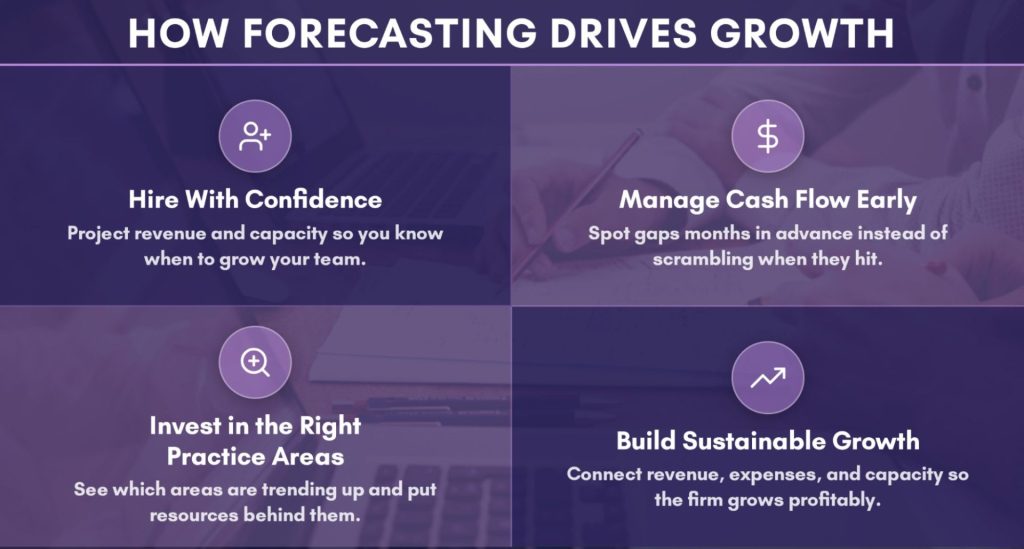
Hiring With Confidence
For smaller firms and mid-sized firms, every hire carries real weight. You’re not backfilling a role in a 50-person department. You’re adding a salary that directly impacts the firm’s cash flow and profitability. Hire too early and you’re carrying payroll you can’t support. Wait too long and you’re burning out your team while turning away work.
A financial forecast takes the guesswork out of this. By projecting revenue and capacity over the next six to twelve months, you can model the cost of a new hire against expected income before making the commitment. You’ll know whether the firm can absorb the expense, when the new hire is likely to become revenue-positive, and what happens to cash flow in the meantime.
Managing Cash Flow Before Problems Show Up
Cash flow issues rarely appear overnight. They build over weeks and months as receivables stretch, expenses climb, or seasonal slowdowns hit. In a three- or four-attorney firm, one slow collection month can create real pressure on payroll and operating expenses.
Cash flow forecasting shows you those gaps in advance. If collections are expected to dip in Q3 but a large tax payment is due the same month, you can plan for it now rather than scrambling later. That kind of visibility is what keeps a growing firm financially stable instead of busy but broke.
Investing in the Right Practice Areas
Not every practice area grows at the same rate, and in a smaller firm you don’t have the margins to invest in all of them equally. Some are generating strong revenue with healthy margins. Others are flat or declining but still consuming your team’s time and resources.
Forecasting helps firm leaders see these trends clearly. If your employment law practice has been trending up for three consecutive quarters while your real estate work has been flat, that data should inform where you invest in marketing, hiring, and business development. For firms offering a range of legal services with limited resources, putting them behind the right revenue source matters more than spreading them thin.
Building Toward Sustainable Growth
Growth without financial visibility is one of the most common traps for firms in the $2M to $10M range. Revenue goes up, the team gets bigger, and the firm feels busier than ever. But if expenses are growing faster than collections, the firm is getting larger without getting stronger.
Accurate forecasting connects revenue, expenses, and capacity into one picture. It shows you whether the firm is growing profitably or just growing. For firm owners who are still actively managing cases while trying to run the business, that kind of long-term visibility is what builds financial stability and makes the difference between a firm that scales and one that plateaus.
Getting Started With Law Firm Forecasting
What You Need to Begin
You don’t need a finance team or expensive software to start forecasting. You need three things:
- Clean historical data: At least 12 months of financial reporting that shows revenue, expenses, and cash flow by month. If your books aren’t in good shape, that’s the first thing to fix.
- A clear picture of your revenue sources: Where does your income come from? Which practice areas, attorneys, and client types are driving it? The more specific you can get, the more useful the forecast will be.
- Someone who owns the process: A forecast only works if someone builds it, updates it, and holds the firm accountable to it. In larger firms, that might be an internal controller or finance director. For most smaller firms and mid-sized firms, it’s a role that doesn’t exist yet.
Where a Fractional CFO Fits
This is where a fractional CFO adds the most value for a firm that’s ready to grow but doesn’t have the internal resources to build and manage a forecast on its own. A fractional CFO builds the model, tracks actual performance against projections, and brings those numbers into regular conversations with firm leadership so the data actually informs decisions.
At Cathcap, we work with legal professionals and law firm owners who want that kind of financial visibility without adding a full-time executive. Whether you’re trying to get ahead of a cash flow gap, plan your next hire, or figure out which practice areas deserve more investment, it starts with a forecast. Book a free consultation to start the conversation.
Frequently Asked Questions
What is law firm forecasting?
Law firm forecasting is the process of projecting your firm’s revenue, expenses, and cash flow over a set period, usually 12 months. It uses historical data, key metrics like billable hours and realization rate, and current revenue trends to give firm leaders a forward-looking picture of the firm’s financial health. The goal is to give you the financial stability that comes from making growth decisions based on data rather than instinct.
How often should a law firm update its financial forecast?
At minimum, monthly. A forecast is only useful when it reflects what’s actually happening in the business. Each month, you compare actual performance against your projections and adjust the model going forward. Some firms update on a rolling basis, where the forecast always looks 12 months ahead and shifts forward each month as new data comes in.
What’s the difference between a forecast and a budget?
A budget is a fixed plan for how you intend to spend over a set period. A financial forecast is a projection of what’s likely to happen based on current data, and it updates as conditions change. A budget tells you what you planned to do. A forecast tells you what’s actually trending and helps you adjust your strategy in real time.
How can Cathcap help my law firm with financial forecasting?
Cathcap provides fractional CFO services built around the needs of law firm owners. Our team builds your forecasting model, tracks actual performance against projections, and brings those numbers into regular conversations with firm leadership. Whether you need help with cash flow forecasting, hiring plans, or practice area investment decisions, we give you the financial visibility to make those calls with confidence. Book a free consultation to get started.


Recent Comments