


The Short Answer: Job costing is the process of tracking every cost tied to a specific construction project, including labor, materials, equipment, and overhead. It tells you whether each job is actually making money or quietly eating into your profit margins.
You know what you bid on a project. You know what you billed the client. But do you know what the job actually cost you? For a lot of construction company owners, the answer is “roughly.” And roughly is where profit margins start to slip.
Most construction businesses track their finances at the company level. Revenue comes in, expenses go out, and if there’s money left over at the end of the month, things feel fine. The problem is that approach hides what’s happening at the job level. A construction company running 15 or 20 jobs at a time can look profitable overall while only a handful of those projects are actually driving profits every month.
Job costing closes the visibility gap. It gives you a clear view of the actual cost of every construction job so you can catch cost overruns early, price future work more accurately, and protect the profit margins that keep your business healthy and growing.
What Is Job Costing?
Job costing tracks every dollar spent on a specific project. That includes labor costs, material costs, equipment costs, overhead expenses, and subcontractor fees. Each construction job gets its own set of cost codes so every expense is assigned to the project it belongs to rather than lumped into one general bucket at the end of the month.
How It Works
For a construction business, job costing looks like this: A crew works on a job site and their labor hours get logged to that specific job. When materials are delivered, the cost gets coded to the same project. Equipment rental, fuel, permits, insurance allocation, and any project expense that touches that job all get tracked the same way.
The goal is to know the actual cost of each construction project in real time, not three weeks after the job is finished. That’s what separates companies that manage their profit margins from ones that just hope the numbers work out.
Why Job Costing Matters for Construction Companies
Protecting Profit Margins
A construction company can look profitable on paper while individual projects are losing money. If you’re running 20 jobs and your monthly profit and loss statement shows a healthy margin, it’s easy to assume everything is working. But without job-level cost tracking, you have no way of knowing whether 5 of those jobs are bleeding cash and the other 15 are covering for them.
Job costing gives you project profitability at the individual job level. When a specific project starts trending over budget, you can see it in real time and make adjustments before it turns into a larger problem.
Tracking What Actually Drives Costs
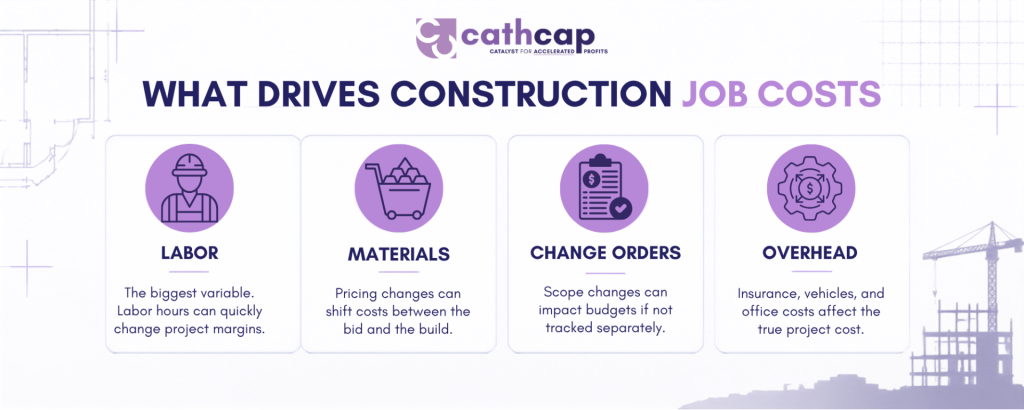
Every construction project has a different cost profile, but the same categories tend to drive the numbers:
- Labor costs and labor hours are usually the biggest variable. A crew that takes 20% longer than estimated on a job can wipe out the expected margin entirely.
- Material costs fluctuate with supply chain pricing and can shift between the bid and the build.
- Change orders alter the scope and budget of a construction project, sometimes significantly. If they aren’t tracked as separate line items, the original estimate becomes meaningless.
- Overhead costs like insurance, vehicles, and office expenses need to be allocated across jobs accurately. Spreading them evenly doesn’t reflect the actual cost each project carries.
When direct costs and indirect costs are tracked separately by cost code, the project manager has a clear picture of whether a specific job is on track or headed for a cost overrun.
Improving Estimates Over Time
One of the biggest long-term benefits of job costing is what it does for your bidding. Every completed project creates a record of actual cost vs. original estimate. Over time, that data shows you where your bids are consistently too low, where you’re leaving margin on the table, and how different project types perform.
A construction firm that tracks this consistently builds more accurate job estimates and more predictable profit margins. That kind of data also puts you in a stronger position to take on larger projects with confidence because you have the financial history to back up your numbers.
What Effective Job Costing Looks Like
The Building Blocks
Job costing only works when the right systems are in place. For most construction businesses, that starts with three things:
- Cost codes: Every expense category (labor, materials, equipment, subcontractors, overhead) gets its own code tied to a specific project. This is what allows you to pull a report on any construction job and see exactly where the money went.
- Real-time tracking: Costs need to be entered as they happen, not batched at the end of the month. A project manager reviewing a job cost report from three weeks ago is looking at a picture that’s already outdated.
- General ledger integration: Your job cost data should flow directly into your financial statements so your books and your project data tell the same story. When those two systems don’t talk to each other, you end up reconciling discrepancies instead of proactively managing your business.
Where Construction Businesses Get It Wrong
Even companies that do some form of job costing often fall into the same traps:
- Waiting until a job is finished to tally costs. By then, the overrun has already happened, and there’s nothing you can do about it.
- Lumping overhead expenses evenly across all jobs. A small residential project and a large commercial build don’t carry the same overhead. Flat allocation hides the true cost of each job.
- Ignoring change orders in the cost tracking. If a change order adds $30,000 in scope but doesn’t get its own line item, the original budget looks blown when it really isn’t.
- Running everything in manual spreadsheets. Spreadsheets work until they don’t. As a construction company grows, disconnected spreadsheets create data gaps, version control issues, and reporting that nobody can trust.
Why This Is a Financial Strategy Decision
Job costing isn’t just a project management exercise. It’s how a construction company builds financial health and real-time visibility into what’s actually driving growth and performance.
When your job cost data connects to your financial statements and cash flow reporting, you can make smarter decisions about which projects to pursue, when to hire, and how to price your next bid. You stop guessing at margins and start managing them.
That connection between job-level data and company-level financial planning is where most construction businesses have a gap. The project managers have their numbers, the bookkeeper has the general ledger, and nobody is tying them together into a complete financial picture.
A fractional CFO helps construction businesses close that gap. At Cathcap, we build the cost code structure, reporting systems, and financial planning processes that turn job cost data into actionable financial performance insights. If your construction company is growing but you don’t have clear visibility into project profitability, let’s start a conversation.
Frequently Asked Questions
What is job costing in construction?
Job costing is the process of tracking all costs tied to a specific construction project, including labor, materials, equipment, subcontractors, and overhead. Each job gets its own cost codes so you can see the actual cost and profit margin on every individual project rather than just the company as a whole.
Why is job costing important for construction companies?
Without job costing, a construction business can look profitable overall while losing money on individual projects. Job costing gives you project-level visibility into where money is going, which projects are performing, and where cost overruns are happening so you can address them before they eat into your margins.
How does a fractional CFO help with job costing?
A fractional CFO builds the systems that connect your job cost data to your financial statements and cash flow reporting. At Cathcap, we help construction companies set up cost code structures, implement real-time tracking processes, and build reporting that ties project-level performance to company-level financial planning. That visibility is what turns job costing from a bookkeeping task into a tool for smarter financial decisions.


Recent Comments